
- Academic Integrity
- What Is Plagiarism?
- Forms of Plagiarism
- Types of Plagiarism
- Plagiarism Detection Systems
- Assessing Plagiarism
- How to Avoid Plagiarism
Academic Integrity
Academic integrity is a principle governing the academic and research activities of researchers, academic staff, and students. It involves adhering to the highest standards of professionalism, accuracy, objectivity, truthfulness, responsibility, honesty, and moral and ethical conduct in academic activities, publications, communication, and public engagement, thereby contributing to the quality and reputation of education and research and to the reputation of the academic environment and institution.
One of the requirements of academic integrity is the prevention of plagiarism.
Academic Integrity Documents
- Code of Ethics for Scientists ( Latvian Academy of Sciences, Latvian Council of Science) (Latvian Academy of Sciences, 2017)
Regarding plagiarism, the Code states:
“2.12. Copying the work of, or fragments from other scientists, without references to the author or source, is considered to be plagiarism or a breach of copyright.
2.13. The repeated publication of one’s previously published works without references to them is ethically unacceptable. One and the same scientific data can be used only if the first publication is indicated”.
- The Academic Ethics Codex of the University of Latvia (Uneversity of Latvia, 2021a)
Section 6 of the document sets out one of the principles of academic ethics:– “Fairness and justice – describe honest, substantiated action based on mutual reliability that prevents the conflict of interests, corruption risk, deception, venality, biased evaluation, or from plagiarism”.
With regard to the study process, the Codex states that: “19. Teaching staff supports and maintains academic and professional integrity by not creating conditions for the manifestations of academic dishonesty, follows the development process of the student papers, provides consultations, ensures feedback, does not allow for plagiarism, cribbing, other kinds of unfair usage of intellectual property, or other kinds of violation of academic integrity” and “32. The students support and maintain academic and professional integrity, do not allow for plagiarism, cribbing, other kinds of unfair usage of intellectual property, or other kinds of cheating.”
In the section on research activities, the Code emphasizes that: “22. Academic personnel and students treat other intellectual property in a fair manner and with respect, not allowing for plagiarism and cheating. As the authors of scientific research and publications should be indicated only those scientists, who have participated in the implementation of a particular scientific research, and in according to the internationally accepted authorship criteria. The publication of collectively performed scientific research results ought to be agreed upon with all co-authors.”
- The Regulations for Academic Integrity at the University of Latvia (Uneversity of Latvia, 2021b)
Dokument “defines what is the academic integrity and related actions to it, enumerates most often occurring violations of principles of the academic integrity in the academic environment, and the UL community’s liability in preventing academic dishonesty. Regulations apply to entire UL community – academic and general personnel, students, including obtaining academic degree, applicants, auditors, and persons, who perform work based on the enterprise’s, author’s, and volunteer’s employment contract.”.
Section 10 of the Regulations provides a detailed explanation of what constitutes plagiarism, while Section 29 provides a comprehensive description of violations of the principles of academic integrity, including plagiarism. It is emphasized that: “28. The administration of the UL provides academic personnel with centralised access to the plagiarism recognition tools for verification of the regular written work during studies.”
The Regulations on Academic Integrity set out the procedure to be followed when a report of a violation of academic integrity or plagiarism is received and specify the potential sanctions for violations of academic integrity, including plagiarism.
What is Plagiarism?
- Plagiarism is presenting another author’s work (published or unpublished), or part of it (including individual phrases, sentences, research data, images, etc.), as well as another author’s ideas, concepts, or arguments, as one’s own and using them without acknowledging the author and the source.
- Plagiarism is a violation of copyright and academic integrity.
- Plagiarized work is a research work, or part of it, that corresponds to another author’s work in terms of content, structure, and argumentation.
- Plagiarism is one of the main forms of misconduct in education, research, and academia, alongside fabrication and falsification (FFP – fabrication, falsification, and plagiarism) (Glossary for Academic Integrity, 2020).
Forms of Plagiarism
- Intentional plagiarism – deliberately using another author’s work without citing it.
- Unintentional plagiarism – unknowingly using material that is similar to previously published work.
- Accidental plagiarism – resulting from insufficient knowledge and understanding of how to cite information resources.
- Irresponsible use of information resources – negligent, inaccurate, or incorrect use and citation of other authors’ works.
- Self-plagiarism – a form of plagiarism involving the direct reuse of one’s own work or part of it, with or without additions, presenting it each time as original work or failing to disclose that the work has previously been published or submitted
Types of Plagiarism
- Presenting another author’s entire work as one’s own.
- Copying and pasting – using part of another author’s work without changing its content or form.
- Patchwork (mosaic plagiarism) – combining fragments obtained from different information resources, with or without appropriate acknowledgement of the sources. The fragments used may be edited or modified.
- Compilation – creating a work by collecting, combining, and processing previously published texts and data to produce a new, original work.
- Paraphrasing – changing the grammatical structures of the source text, replacing words, or rearranging sentences without acknowledging the original source.
- Translation – translating a work from its original language and using the translation without citing the source.
- Citing non-existent or unused information resources, or providing incomplete or inaccurate information about a resource in a citation, reference, or bibliography to the extent that the resource cannot be located and identified.
- Idea plagiarism – using another author’s idea, concept, opinion, or argument without citing the source. Common knowledge may be used without citation, and attribution is not required if the author cannot be identified.
- Template plagiarism – using template text (for example, an introduction, conclusions, structure of a paper, footnotes, etc.) or language without acknowledging the original source.
- Plagiarism of visual materials and works of art – using images, graphs, tables, multimedia works, or other visual materials without the author’s permission or without acknowledging the source.
- Code plagiarism – using algorithms, program code, or functions without permission or acknowledgement.
- Excessive citation – a form of indirect plagiarism in which the work is not formally plagiarized: the author properly acknowledges all information resources used, paraphrases them, and formats quotations correctly. However, the work lacks originality because it contains almost no content created by the author and essentially consists of a sequence of other authors’ works. Such a work therefore cannot be regarded as a contribution to academic research or as sufficient for obtaining an academic degree.
- Contract cheating or purchasing academic work.
10 types of Plagiarism by Turnitin community
- Presenting another author’s work as one’s own.
- Copying substantial portions of text from another work without making any changes to its content.
- Replacing keywords and phrases while retaining the essential content of the original work – the “find-and-replace” approach.
- Combining paraphrased material from several works, or parts thereof, into a single text.
- Reusing part or all of one’s own previous work without citing it – self-plagiarism.
- Combining correctly cited material with copied passages that are not properly acknowledged – hybrid plagiarism.
- Combining multiple copied text fragments – mosaic plagiarism.
- Citing non-existent information resources or providing inaccurate information about them.
- Properly citing the information resources used but making no original contribution of one’s own.
- Using correct citations while retaining too much of the structure and content of the cited work.
Plagiarism Detection Systems
- Text-matching software
- The system checks the submitted work, identifies matching text, and generates a similarity report by comparing it with other information resources included in the system’s databases, such as online resources, books, journal articles, conference papers, and student papers.
- It is useful to check not only papers submitted by students but also articles, scientific and technical reports, textbooks, teaching materials, and other resources prepared by academic, research, and other staff.
- Potential instances of plagiarism identified by the system are assessed and interpreted by an expert or a panel of experts.
Since 2014, Latvian higher education institutions have used the Unified Computerised Plagiarism Detection System.
The University of Latvia and Rīga Stradiņš University also use the text-matching tool Turnitin. Turnitin provides the Originality Check service, which automatically identifies similarities between the submitted work and other sources and indicates the proportion of potentially non-original content.
Assessing Plagiarism
When determining the severity of plagiarism, the following factors are considered:
- the extent of the material used (from a few words to an entire work);
- the originality of the material used (from common knowledge to an original idea);
- the location and context of the plagiarized material within the work (theoretical section, methodology or hypothesis, conclusions);
- the author’s experience in academic writing and research (e.g., a bachelor’s student or a senior researcher).
When assessing plagiarism, it is important to determine the severity of the violation.
Minor violations include:
- an incorrectly formatted quotation without dishonest intent;
- plagiarism in a minor assignment or in a very small part of a substantial independent work;
- unauthorized collaboration with another student on a minor assignment;
- citing an information resource that was not used in a minor assignment;
- “accidental” or “unintentional” plagiarism in part of a survey or in the research methodology of a work
Major violations include:
- substantial plagiarism in a major assignment;
- plagiarism in a significant section of a work (for example, the hypothesis in a final thesis, theft of research ideas, research results, or conclusions);
- multiple minor violations (Glossary of Academic Integrity Terms, 2020).
The European Network for Academic Integrity recommends that decisions concerning minor plagiarism committed by students should emphasize further learning. Therefore, possible measures may include a warning, a requirement to revise and resubmit the work, or a requirement to complete an additional academic writing course. Lēmumos par nozīmīgu un/vai tīšu pārkāpumu var tikt piespriests nopietnāks soda mērs, tai skaitā studiju pārtraukšana vai atskaitīšana. Abos gadījumos mēri ir jāpieņem konsekventi, pārredzami un taisnīgi (Akadēmiskā godīguma terminu vārdnīca, 2020).
The Regulations on Academic Integrity at the University of Latvia classify violations of academic integrity according to their severity as follows:
- 8.1. Unwelcome practice (Stage 1) – minor infringement, committed due to ignorance or without malicious intent and does not cause significant consequences to the academic activity of the UL community representative or does not cause harm to the UL; the decision on the consequences of the unwelcome practice is made by the teaching staff or supervisor.;
- 8.2. Serious violation (Stage 2) – inadmissible behaviour in the academic environment, which regardless of volume and intent causes negative consequences to the to the academic activity of the UL community representative or cause harm to the UL; the decision on the consequences of the serious violation is made by the Head of the Department.;
- 8.3. Severe violation (Stage 3) – inadmissible behaviour in the academic environment, which is performed with malicious intent and causes significant negative consequences to the to the academic activity of the UL community representative or cause serious harm to the UL; the decision on the consequences of the serious violation is made by the Rector of the UL or authorised person, in accordance with the proposal of the dean’s or the Academic Ethics Commission of UL.” (Latvijas Universitāte, 2021b).
How to Avoid Plagiarism
- Study – acquire knowledge and familiarize yourself with as many scholarly information resources as possible.
- Learn to think independently, understand, analyse, and assimilate information.
- Develop your knowledge of academic integrity, citation, and plagiarism.
- Make an effort to understand the requirements of your assignments, and consult and cooperate with your supervisor.
- Develop your academic writing skills.
- Allow sufficient time for research and academic writing, and prepare a research plan (at least an approximate one) with specific tasks and deadlines.
- Cite sources correctly and responsibly – acknowledge the information resources used and the authors of the ideas..
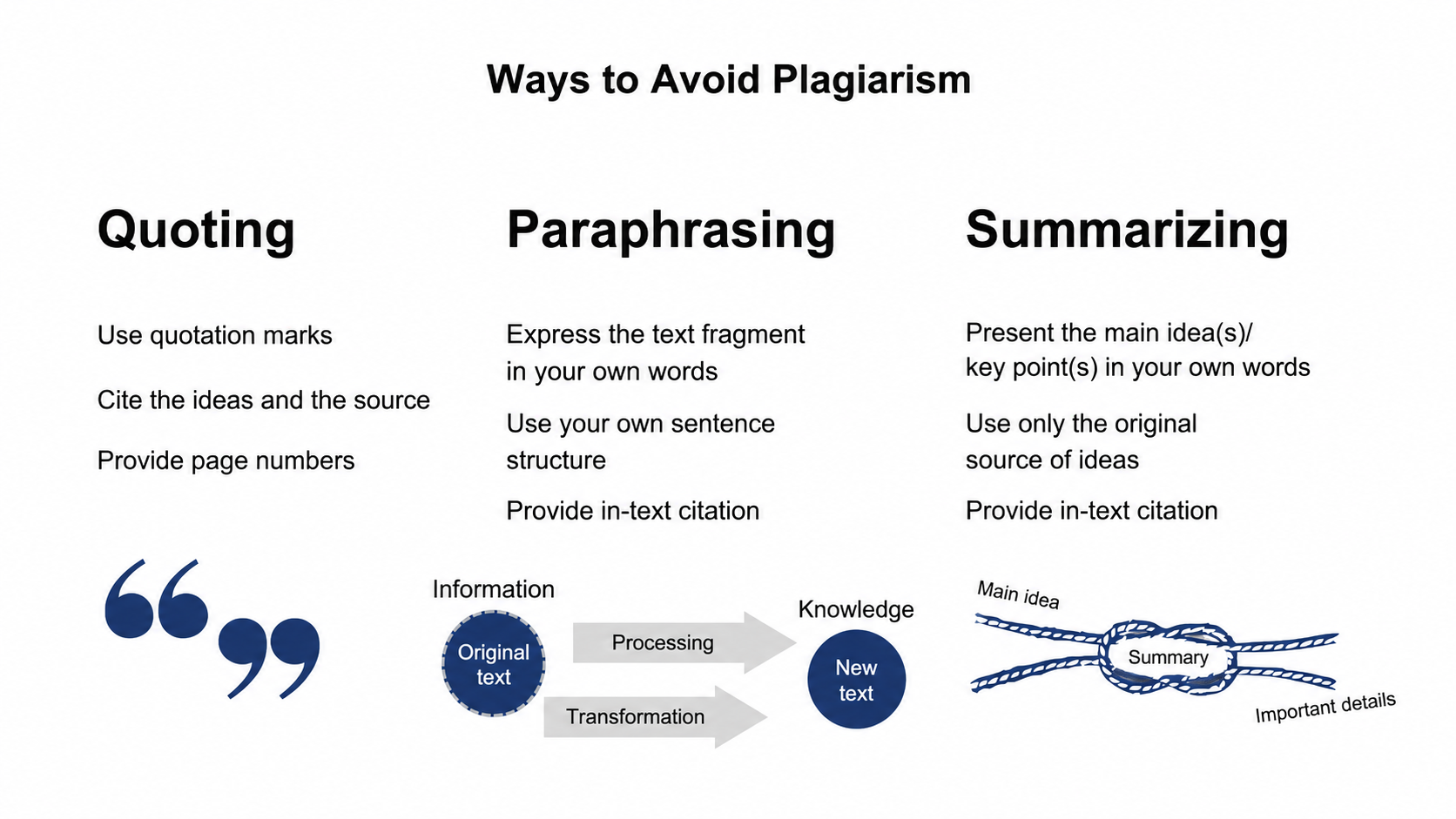
Fig. 1. Ways to Avoid Plagiarism (Foltýnek, & Sivasubramaniam, 2018)
References
Akadēmiskā godīguma terminu vārdnīca. Akadēmiskā godīguma vispārējās vadlīnijas (uzziņu izdevums). (2020). Rīgas Tehniskās universitātes izdevniecība. https://dom.lndb.lv/data/obj/834560.html
Ābula, M. (2017). Plaģiāts akadēmiskajā vidē. Akadēmiskā Dzīve, 53, 118-122. https://doi.org/10.22364/
Foltýnek T., & Sivasubramaniam, S. (2018). Kā izvairīties no plaģiātisma: parafrāzēšana, citēšana un apkopošana. https://www.academicintegrity.eu/materials/91
Latvijas Universitāte. (2021a). Latvijas Universitātes Akadēmiskās ētikas kodekss. https://www.lu.lv/fileadmin/user_upload/LU.LV/www.lu.lv/Dokumenti/Dokumenti_LV/1._VISPAREJIE_DOKUMENTI/SL_2-3-46-2021_LU_Akademiskas_etikas_kodekss.pdf
Latvijas Universitāte. (2021b). Noteikumi par akadēmisko godīgumu Latvijas Universitātē. https://www.lu.lv/fileadmin/user_upload/LU.LV/www.lu.lv/Dokumenti/Dokumenti_LV/1._VISPAREJIE_DOKUMENTI/SL_2-3-48-2021_Noteikumi_par_akad_god_LU.pdf
Latvijas Zinātņu akadēmija, Latvijas Zinātnes padome. (2017). Zinātnieka ētikas kodekss. https://www.lza.lv/par-mums/pamatdokumenti/64-zinatnieka-etikas-kodekss
Plagiarism.org. (2017). https://www.plagiarism.org/